Bone & Joint Health Guide
Osteoporosis: The Silent Bone Disease — Prevention, Testing and Building Stronger Bones at Any Age
Osteoporosis causes no symptoms until a bone breaks — often from a minor fall. The good news: bone loss is detectable early and largely preventable at any age.
What is osteoporosis?
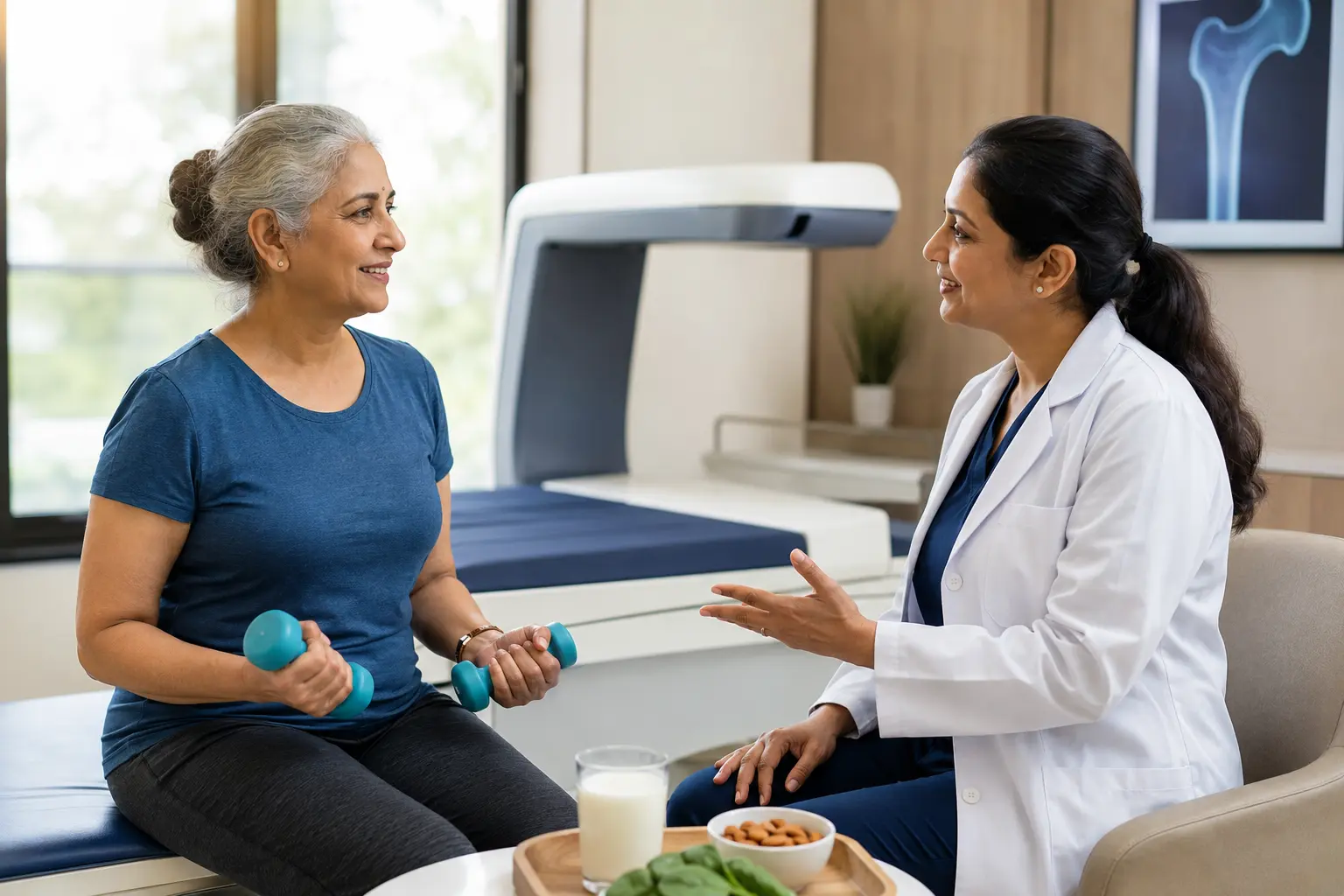
Bone is living tissue, constantly being broken down and rebuilt. Until about age 30 we build more than we lose; after that, the balance slowly tips. Osteoporosis develops when bone is lost faster than it is replaced, leaving bones porous and fragile — fragile enough that a minor fall, a cough, or even bending can cause a fracture.
It is called the silent disease because there are no symptoms until a fracture occurs. The most common sites are the wrist, the spine (causing height loss and a stooped back) and — most seriously — the hip.
Who is at risk?
In India the risk is amplified: vitamin D deficiency is widespread despite our sunlight (largely due to indoor lifestyles and skin coverage), and dietary calcium intake is frequently below requirement.
- Women after menopause (oestrogen protects bone; its loss accelerates bone thinning)
- Men over 65
- Anyone with a parent who had a hip fracture
- People with low body weight or a small frame
- Long-term steroid users (for asthma, arthritis, skin conditions)
- Smokers and those with high alcohol intake
- People with vitamin D deficiency, thyroid disorders, diabetes or kidney disease
- Anyone who had a fracture from a minor fall after age 50 — that fracture itself is the strongest warning sign
Testing: the DEXA scan
Bone density is measured with a DEXA scan — a quick, painless, low-radiation test of the hip and spine that takes about 15 minutes. The result (T-score) tells whether your bones are normal, thinning (osteopenia) or osteoporotic, and helps decide whether you need treatment beyond lifestyle measures.
We recommend a baseline DEXA for women at menopause and men at 65 — earlier for anyone with the risk factors above or a previous fragility fracture. Where indicated, we coordinate the scan and plan treatment at our clinic.
Building and protecting bone at every age
- Calcium: adults need roughly 1,000–1,200 mg daily — milk, curd, paneer, ragi, sesame, leafy greens and almonds are excellent sources
- Vitamin D: the single most common deficiency we see; get 15–20 minutes of midday sun on arms/legs several times a week, and test and supplement when levels are low
- Weight-bearing exercise: brisk walking, stair climbing and resistance training directly stimulate bone formation
- Protein: adequate intake supports the bone matrix — important for vegetarians to plan consciously
- Stop smoking and moderate alcohol — both accelerate bone loss
- Prevent falls at home: good lighting, removing loose rugs, grab bars in bathrooms for seniors
Treatment when osteoporosis is confirmed
Lifestyle measures are the foundation but not always sufficient. Proven medications — including bisphosphonates, and newer agents that actively build bone — reduce fracture risk substantially, particularly after a first fracture. Treatment is individualised based on your DEXA score, age, fracture history and other conditions.
The most important message: a fragility fracture is not just bad luck — it is a diagnosis. Anyone who breaks a bone from a simple fall after 50 should have their bone health evaluated, because treating osteoporosis after the first fracture is far better than after the second.
FAQ
Common Questions About This Topic
Keep reading
More Bone & Joint Guides
Bone & Joint Health
Knee Replacement Surgery: 7 Signs It May Be Time — and What Recovery Really Looks Like
Knee replacement is not about age or X-rays alone — it is about how much your knee limits your life. Here are the signs that suggest it is time to discuss surgery.
Read articleBone & Joint Health
ACL Injury: Complete Guide to Treatment, Surgery and the Road Back to Sport
A 'pop', rapid swelling and a knee that feels unstable — the classic ACL tear. Here is how treatment decisions are made and what the road back to sport really involves.
Read articleBone & Joint Health
Frozen Shoulder: Why It Happens, the 3 Stages, and Exercises That Speed Recovery
A shoulder that slowly stiffens until even combing your hair hurts — frozen shoulder follows a predictable pattern, and the right exercises genuinely shorten recovery.
Read article
Need Help Deciding Which Specialist to Consult?
Tell us your concern and the clinic team will guide you to the right consultation.
Prefer a callback?
Leave your number and the clinic will call you back.