Bone & Joint Health Guide
ACL Injury: Complete Guide to Treatment, Surgery and the Road Back to Sport
A 'pop', rapid swelling and a knee that feels unstable — the classic ACL tear. Here is how treatment decisions are made and what the road back to sport really involves.
What is the ACL and how does it tear?
The anterior cruciate ligament (ACL) is the key stabiliser inside the knee, controlling forward slide and rotation of the shin bone. It tears most often during sports — a sudden change of direction, an awkward landing from a jump, or a tackle — in football, cricket, kabaddi, badminton and basketball. Interestingly, most ACL tears happen without any contact at all.
Women are 2–8 times more prone to ACL tears than men in the same sport, due to a combination of anatomy, landing mechanics and hormonal factors.
Recognising an ACL tear
Diagnosis is made by clinical examination — specific stability tests performed by the orthopaedic surgeon — and confirmed with an MRI, which also reveals associated meniscus or cartilage damage found in over half of ACL injuries.
- A distinct 'pop' felt or heard at the moment of injury
- Rapid swelling within a few hours
- Inability to continue playing
- A feeling that the knee 'gives way' or buckles, especially on turning
- Later: instability during cutting, pivoting or walking on uneven ground
Surgery or no surgery? How the decision is made
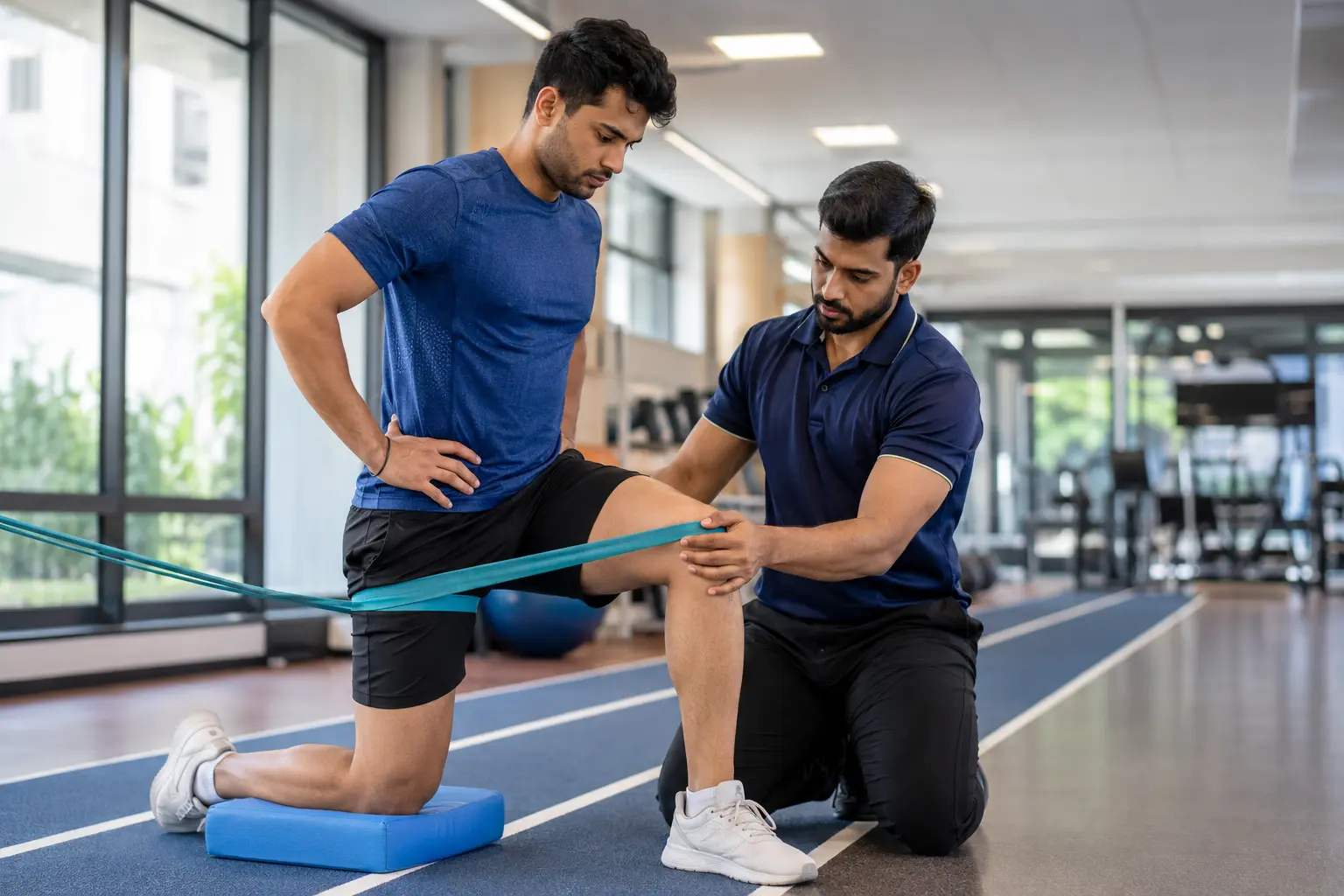
The ACL cannot heal reliably on its own, but not every tear needs an operation. Non-surgical management with structured physiotherapy can work for patients with a partial tear, low sporting demands, or a stable knee on examination. For active patients who want to return to pivoting sports — or whose knee keeps giving way — arthroscopic ACL reconstruction is the definitive treatment.
In reconstruction, the torn ligament is replaced with a graft — usually your own hamstring tendons — fixed through tiny keyhole incisions. At Dr. Murkute's O2 Bone & Eye Care Clinic, Dr. Vishal Murkute performs arthroscopic ACL reconstruction with fellowship training specifically in arthroscopy and sports medicine.
The recovery timeline, honestly
Returning too early is the biggest risk factor for re-tear. Clearance is based on strength and movement testing — not just the calendar.
- Weeks 0–2: Swelling control, regaining full straightening, walking with crutches
- Weeks 2–6: Restoring knee bend, building quadriceps strength, walking normally
- Months 2–4: Strength training, cycling, swimming, straight-line jogging (typically around month 3)
- Months 4–6: Agility drills, sport-specific exercises, hopping and direction change
- Months 6–9: Gradual return to full training; return to competitive pivoting sport typically at 9–12 months
Preventing ACL injuries
- Structured warm-up programmes (like FIFA 11+) reduce ACL injuries by up to 50%
- Strengthen hamstrings and gluteal muscles, not just quadriceps
- Practise landing softly with knees aligned over toes
- Build core stability — trunk control directly affects knee loading
- Increase training load gradually; sudden spikes in intensity raise injury risk
FAQ
Common Questions About This Topic
Keep reading
More Bone & Joint Guides
Bone & Joint Health
Knee Replacement Surgery: 7 Signs It May Be Time — and What Recovery Really Looks Like
Knee replacement is not about age or X-rays alone — it is about how much your knee limits your life. Here are the signs that suggest it is time to discuss surgery.
Read articleBone & Joint Health
Frozen Shoulder: Why It Happens, the 3 Stages, and Exercises That Speed Recovery
A shoulder that slowly stiffens until even combing your hair hurts — frozen shoulder follows a predictable pattern, and the right exercises genuinely shorten recovery.
Read articleBone & Joint Health
Slip Disc and Sciatica: Why 9 Out of 10 Patients Never Need Surgery
A slipped disc sounds frightening, but the vast majority of patients recover fully without surgery. Understanding the condition is the first step to beating it.
Read article
Need Help Deciding Which Specialist to Consult?
Tell us your concern and the clinic team will guide you to the right consultation.
Prefer a callback?
Leave your number and the clinic will call you back.