Eye Health Guide
Children's Eye Health in the Screen Age: Myopia, Warning Signs and the Right Age for a First Eye Test
Childhood myopia is rising sharply across India, and screen habits are a major driver. Early eye examinations catch problems while they are still easy to correct.
Why children's eye problems go unnoticed
Children rarely complain about poor vision — because they have no reference for what 'normal' sight looks like. A child who has always seen the board blurry assumes everyone sees it that way. Vision problems are often discovered only when teachers notice squinting, or when a routine school screening flags them.
Undetected vision problems affect reading speed, attention, sports performance and self-confidence. Some conditions, like lazy eye (amblyopia), can only be corrected effectively if treated before the age of 7–8 — making early checks genuinely time-critical.
Warning signs every parent should watch for
- Sitting very close to the TV or holding books/screens very near the face
- Frequent eye rubbing, blinking or squinting
- Tilting the head or covering one eye to see
- Complaints of headaches, especially after school
- One eye turning inwards, outwards, upwards or downwards (squint)
- Losing place while reading, skipping lines, or avoiding reading altogether
- Poor hand-eye coordination — frequently bumping into things or missing catches
Screens and the myopia epidemic
Near work — phones, tablets, long study hours — combined with too little outdoor time is strongly linked to the development and progression of myopia (minus power) in children. Research consistently shows that children who spend at least 2 hours outdoors daily have a significantly lower risk of developing myopia; natural light and distance viewing are protective.
We recommend practical limits rather than impossible bans: age-appropriate screen time, the 20-20-20 rule during study, holding devices at least an arm's length away, and — most powerfully — daily outdoor play.
When should your child have an eye test?
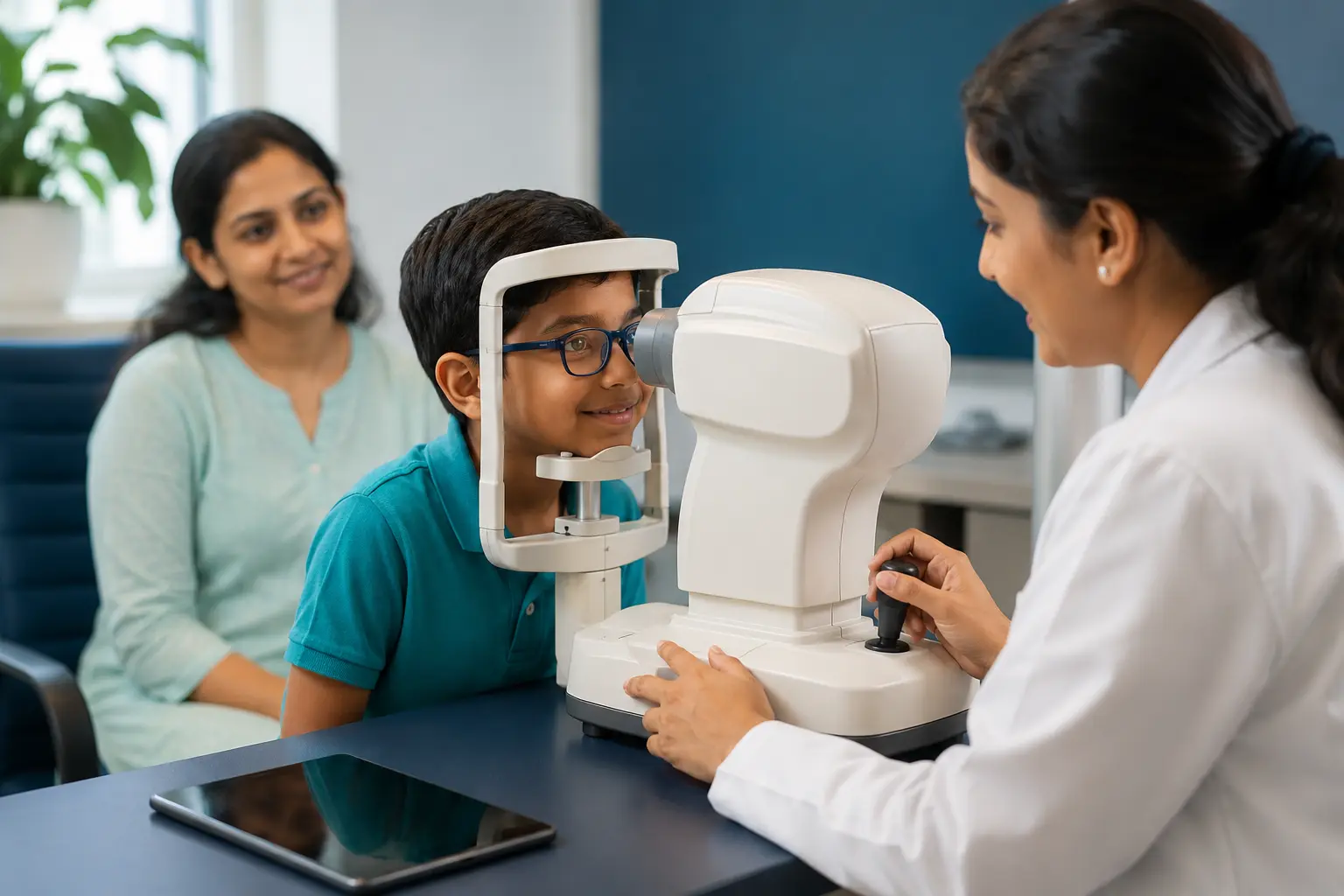
A paediatric eye examination is gentle and child-friendly. We check vision with age-appropriate charts, assess eye alignment, and use cycloplegic (relaxing) drops where needed to measure the true spectacle power — children's focusing is so strong that power is easily overestimated without them.
- First comprehensive check: around age 3–4, or earlier if anything looks abnormal
- Pre-school check: before starting formal school (age 5–6)
- Every 1–2 years thereafter, or yearly if the child wears glasses
- Immediately, at any age, if you notice squint, head tilting or any warning sign above
Common childhood eye conditions we treat
- Myopia (near-sightedness) — glasses plus myopia-control strategies
- Hyperopia and astigmatism — corrected with glasses
- Amblyopia (lazy eye) — glasses and patching therapy; most effective before age 7–8
- Squint (strabismus) — glasses, exercises or surgery depending on type
- Allergic eye disease — very common in children; controlled with the right drops and habits
- Blocked tear ducts in infants — often resolves; massage or a small procedure if persistent
FAQ
Common Questions About This Topic
Keep reading
More Eye Health Guides
Eye Health
Cataract Surgery Recovery: A Day-by-Day Timeline with Do's and Don'ts
Modern phacoemulsification cataract surgery takes about 10–15 minutes, but knowing what to expect each day after surgery makes recovery smooth and stress-free.
Read articleEye Health
Dry Eye Syndrome: Why Screen Time Is Drying Out Your Eyes — and What Actually Helps
If your eyes burn, feel gritty or water excessively after a day at the computer, you may have dry eye disease — one of the most common conditions we treat in Pune's IT workforce.
Read articleEye Health
Glaucoma: The Silent Thief of Sight — Early Signs, Screening and Why 40+ Adults Should Test
Glaucoma causes permanent vision loss without pain or obvious early symptoms. The only reliable protection is regular screening — especially after age 40.
Read article
Need Help Deciding Which Specialist to Consult?
Tell us your concern and the clinic team will guide you to the right consultation.
Prefer a callback?
Leave your number and the clinic will call you back.